African pygmy hedgehog standard
Atelerix albiventris
Version 1.0 · Effective 10 November 2026
Taxonomy
| Kingdom | Animalia |
|---|---|
| Phylum | Chordata |
| Class | Mammalia |
| Order | Eulipotyphla |
| Family | Erinaceidae |
| Subfamily | Erinaceinae |
| Genus | Atelerix |
| Species | Atelerix albiventris |
Common names
African pygmy hedgehog · Witbuikegel
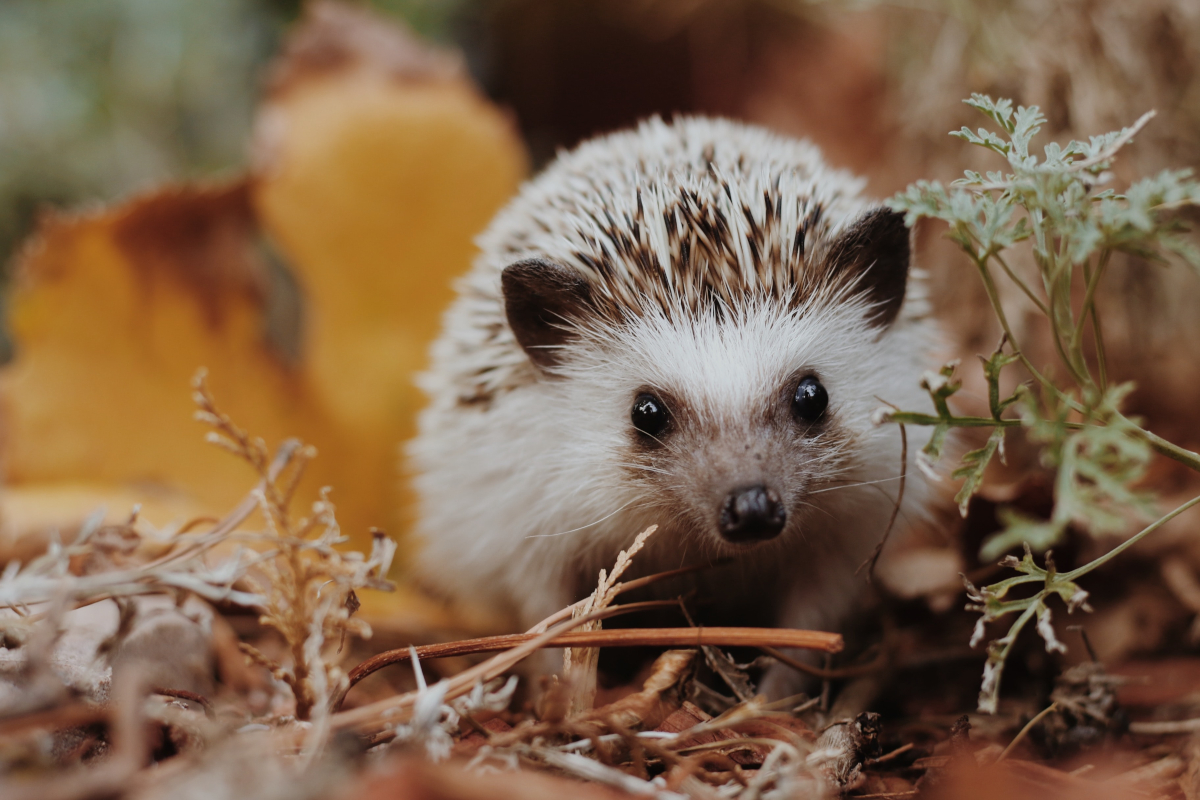
The African pygmy hedgehog is a small, oval-bodied hedgehog with short legs, a short tail and four toes on each hind foot. The back is covered with short, banded spines with a white base and tip, and the face, legs and belly are covered with soft fur. A healthy animal is alert, curious and in good condition: it can roll up completely, walks with its belly raised off the ground and unrolls to explore once it feels safe.
The standard
Head
The head is broad at the back and tapers evenly towards the snout, in proportion to the body. A narrow, spine-free parting runs along the top of the head. The face is covered with short, soft fur. The jaw closes evenly, with no visible swelling of the cheeks or gums.
Faults
Head too narrow or too heavy for the body. Uneven or asymmetrical face. Swelling of the face, jaw or gums (also see Disqualifying faults). Crusting or hair loss on the face.
Ears
The ears are rounded, upright and in proportion to the head, at about 1.5 to 2.8 cm long. The edges are smooth and clean, and the inside of the ear is clean and dry, without discharge or smell.
Faults
Ears very small or very large for the head. Dry, crusty or ragged ear edges. Dirt, wax or crusts inside the ear. Discharge or a bad smell from the ear (disqualifying if signs of infection).
Eyes
The eyes are round, clear, bright and evenly set on both sides of the head. They are neither sunken nor bulging. Eye colour matches the animal's colour as described in the Registry colour standards. The area around the eyes is clean and free of crusts.
Faults
Dull or slightly watery eyes. Eyes of uneven size. Crusts around the eyes. Bulging, cloudy, injured or discharging eyes are disqualifying.
Snout
The snout is long, pointed and straight. The nose is moist and clean, with no discharge. The teeth are white and the gums evenly pink. Upper and lower jaws meet properly.
Faults
Short or crooked snout. Dry, cracked or crusty nose. Discharge from the nose (disqualifying if combined with breathing problems). Tartar, red gums or missing teeth. Poor bite or malformed jaw (disqualifying).
Body
The body is oval, compact and well-muscled, with a smooth, even back line. Seen from above, the body is wider at the hips than at the shoulders, without hollow flanks. The animal can roll up into a complete, closed ball. When walking, it carries its belly off the ground.
Faults
Body too long, too short or out of proportion. Uneven or dipped back line. Fat pads in the armpits or around the rump. Thin body with visible spine or hips. Inability to roll up completely (disqualifying).
Hindquarters
The hindquarters are well rounded and strong. The hind legs support the body evenly. The animal stands and walks steadily, without wobbling, swaying or dragging its hind legs.
Faults
Narrow or weak hindquarters. Uneven stance. Fat deposits around the rump. Any wobbling, weakness or dragging of the hind legs is disqualifying, as these can be early signs of WHS.
Tail
The tail is short, at about 1 to 2.5 cm, and often barely visible under the spines and fur. It is clean, complete and free of wounds or swelling.
Faults
Kinked, damaged or missing tail. Dirt or droppings around the tail and vent, which can point to digestive problems.
Legs and feet
The legs are short, straight and covered with fur. The front feet have five toes. The hind feet have four toes; the first toe is missing or very small. Nails are of normal length and do not curl. The feet are clean, with no swelling, wounds or threads wrapped around the toes.
Faults
Bowed or crooked legs. Overgrown or curled nails. Missing toes from injury (scored down, not disqualifying). A small first toe on the hind foot is a natural variation and is not a fault; a fully developed fifth toe does not meet the standard. Swollen feet, sores or lameness are disqualifying.
Coat
The face, legs and belly are covered with soft, dense, non-spiny fur. In most colours the belly fur is white or very light. The fur is clean and even, without bald patches, matting or staining. The skin underneath is healthy, without redness or scaling.
Faults
Thin or patchy fur. Staining from urine or droppings. Dry, scaly or red skin. Bald patches or crusts (disqualifying if they point to active skin disease).
Spines
The spines cover the back and top of the head, are about 1.5 to 1.7 cm long on the back and lie evenly in a full, dense mantle. The spines are smooth and unbarbed, with a white base and tip and a coloured band in between, according to the animal's colour. A narrow parting runs along the top of the head. The skin between the spines may be slightly dry, but is free of crusts.
Faults
Thin or uneven spine mantle. Broken or damaged spines. Heavy flaking or dandruff between the spines. Bald patches in the mantle, crusts at the base of the spines or visible mites are disqualifying.
Colour and pattern
Colour and pattern are judged according to the Registry colour standards for the African pygmy hedgehog. The colour is clear and even across the whole spine mantle, and the pattern matches the registered colour. Eye colour, nose colour and the colour of the fur fit the registered variety.
Faults
Colour or pattern does not match the registered variety. Uneven or patchy colour that does not belong to the pattern. Colour is never scored higher than health: an animal with excellent colour but poor condition is not rewarded.
General notes
This standard describes a healthy, well-built African pygmy hedgehog. It is meant to support responsible breeding and fair judging. Health, condition and temperament always come before colour or show qualities. An animal with signs of disease is never rewarded, however good its appearance.
The African pygmy hedgehog kept as a pet is bred in captivity worldwide, but it has not been domesticated in the way cats or dogs have. Its behaviour is still largely that of a wild animal.
Sexual maturity is reached early, at around two to three months. Young should be separated by sex by about eight weeks of age to prevent unplanned and too-early pregnancies.
Size and weight
Adult head–body length is about 14 to 26 cm, with a short tail of about 1 to 2.5 cm. Adults usually weigh between 250 and 600 g; captive animals can reach up to 900 g, but such high weights are often a sign of obesity.
Sources differ on which sex is larger, so weight alone is not used to judge an animal. Condition matters more than the number on the scale. A hedgehog in good condition can roll up into a complete, closed ball without fat bulging out, has no fat pads in the armpits or around the rump, and does not show protruding hip bones or spine. Both overweight and underweight animals are faulted.
Temperament
The African pygmy hedgehog is solitary and mainly active at night. Adults should be housed alone, as they can fight. When alarmed, a hedgehog may huff, hiss, raise its forehead spines or roll into a ball. This is normal defensive behaviour and is not a fault in itself.
A well-socialised hedgehog relaxes and unrolls within a reasonable time, then sniffs and explores its surroundings. Self-anointing, where the hedgehog chews a new or strong-smelling substance and spreads frothy saliva over its spines, is normal behaviour. Regular, calm handling from about three weeks of age helps young develop into confident adults.
An animal that stays rolled up for a very long time, or that is unusually aggressive, may be stressed, in pain or unwell. Such behaviour should be noted and the animal checked for health problems.
Health and welfare
African pygmy hedgehogs live on average four to six years and can reach eight years or more. Several serious conditions are common in this species, and breeders have an important role in reducing them.
Wobbly Hedgehog Syndrome (WHS) is a progressive neurological disease that usually starts with wobbling and weakness in the hind legs and can lead to complete paralysis. There is no cure. The cause is not fully known, but a hereditary basis is strongly suspected. Signs can appear at any age, and some animals carry the disease without visible signs. Animals with WHS, and animals with a close relative affected by WHS, should not be bred. In the Registry, WHS reports are always public.
Tumours are very common, especially from three years of age, and most are malignant. Common types include mammary tumours, uterine tumours, oral tumours and lymphoma.
Other common problems include dental and gum disease, heart disease (cardiomyopathy), obesity and skin disease caused by mites or fungal infections. Some of these skin infections can spread to people.
Hedgehogs need a stable warm environment. Below about 20 °C they can fall into torpor, a dangerous low-energy state. Healthy breeding animals have a good body condition, clean skin and spines, healthy teeth and a normal gait.
Disqualifying faults
An animal is disqualified from judging, and should not be used for breeding, if it shows any of the following:
- Neurological signs, such as wobbling, a head tilt, circling, weakness or dragging of the hind legs, or an inability to roll up.
- A confirmed WHS diagnosis, or WHS in a parent or full sibling.
- Visible lumps, swellings or masses, including swollen gums.
- Active skin disease: crusts, heavy flaking, red or inflamed skin, bald patches in the spine mantle or visible mites.
- Eye problems: a bulging, cloudy, injured or discharging eye.
- Severe dental disease: loose or broken teeth, red and swollen gums, or a bad smell from the mouth.
- Obesity that prevents the animal from rolling up completely, or clear underweight with visible hip bones or spine.
- Breathing problems, such as noisy or laboured breathing or discharge from the nose.
- Congenital deformities, such as a malformed jaw, spine or limbs.
- Lameness or a swollen foot or toe.
- Pregnant or nursing females.
Notes for shows
Judges assess the whole animal in calm conditions, with health and temperament first. A short health check takes place before judging; animals with signs of disease or parasites are excluded and the table is cleaned before the next animal. Because some skin infections in hedgehogs can spread to other animals and to people, hands or gloves are cleaned between animals.
Give the hedgehog time to unroll on its own. Never use water, blowing or force to make it unroll. A hedgehog that stays rolled up is not penalised for that alone, but must be assessed again later if possible. Huffing and raising the forehead spines are normal defensive behaviour.
Look for a well-balanced, oval body with a smooth, even back line, a full and even spine coat and a clean, healthy face. Do not reward extreme size or a heavy, rounded body: a fat hedgehog is not in better condition. Colour is judged according to the Registry colour standards, and never above health.
These show notes are THP guidance. There is very little scientific literature on hedgehog shows, so they are based on veterinary welfare advice and good practice from other small-animal standards.
Recognised colours and patterns: Dark Grey, Mocca Dark Grey, Black, Brown, Mocca Brown, Chocolate, Grey, Mocca Grey, Slate Blue, Cinnicot, Mocca Cinnicot, Pink Eyed Black, Cinnamon, Mocca Cinnamon, Lilac, Apricot, Mocca Apricot, Fawn, Pale Apricot, Mocca Pale Apricot, Copper, Blonde, Mocca Blonde, Champagne, Albino, Pinto, Reversed Pinto, Full Reversed Pinto, Masked Pinto, Snowflake, White, Double White, Umbrous, Ticking